The Problem:
Across the globe, cities are grappling with a perfect storm of demographic and economic challenges. Housing affordability is at an all-time low, the cost of living is soaring, and we have a rapidly ageing population that wishes to “age in place” rather than move into institutional care. At the centre of this storm is the “sandwich generation”—adults struggling to afford childcare while simultaneously managing the care of their ageing parents.
Ironically, while young families and essential workers are priced out of the housing market, our established suburbs are full of large, underutilised family homes inhabited by "empty nesters."
The solution to these overlapping crises might already be available. It is time we look toward creating “multi-generational housing”—not just as a cultural tradition, but as a deliberate, policy-driven response to the housing crisis.
How Other Jurisdictions Are Leading the Way
Governments around the world are waking up to the reality that zoning rules built exclusively for the nuclear family are no longer fit for purpose. They are actively implementing policies to encourage multi-generational living:
Canada: Recognising the financial burden of modifying a home for extended family, the Canadian government recently introduced the Multi-Generational Home Renovation Tax Credit. This policy provides a 15% tax refund on up to $50,000 of renovation costs for homeowners who build a self-contained secondary suite for a senior or disabled relative.
Singapore: The Housing & Development Board (HDB) has introduced "3Gen flats." These apartments are architecturally designed specifically for multi-generational living, featuring extra bedrooms and en-suite bathrooms to allow young couples to live comfortably alongside their aging parents under one roof.
California, USA: Through sweeping Accessory Dwelling Unit (ADU) legislation, California has effectively overridden restrictive local zoning laws. This has made it incredibly easy for homeowners to convert garages, partition large homes, or build backyard "granny flats" to house extended family or generate rental income, sparking a boom in "missing middle" housing.
A Practical Proposal: Multi-Generational Homes as Complying Development
While international examples are inspiring, we need localised planning solutions for NSW.
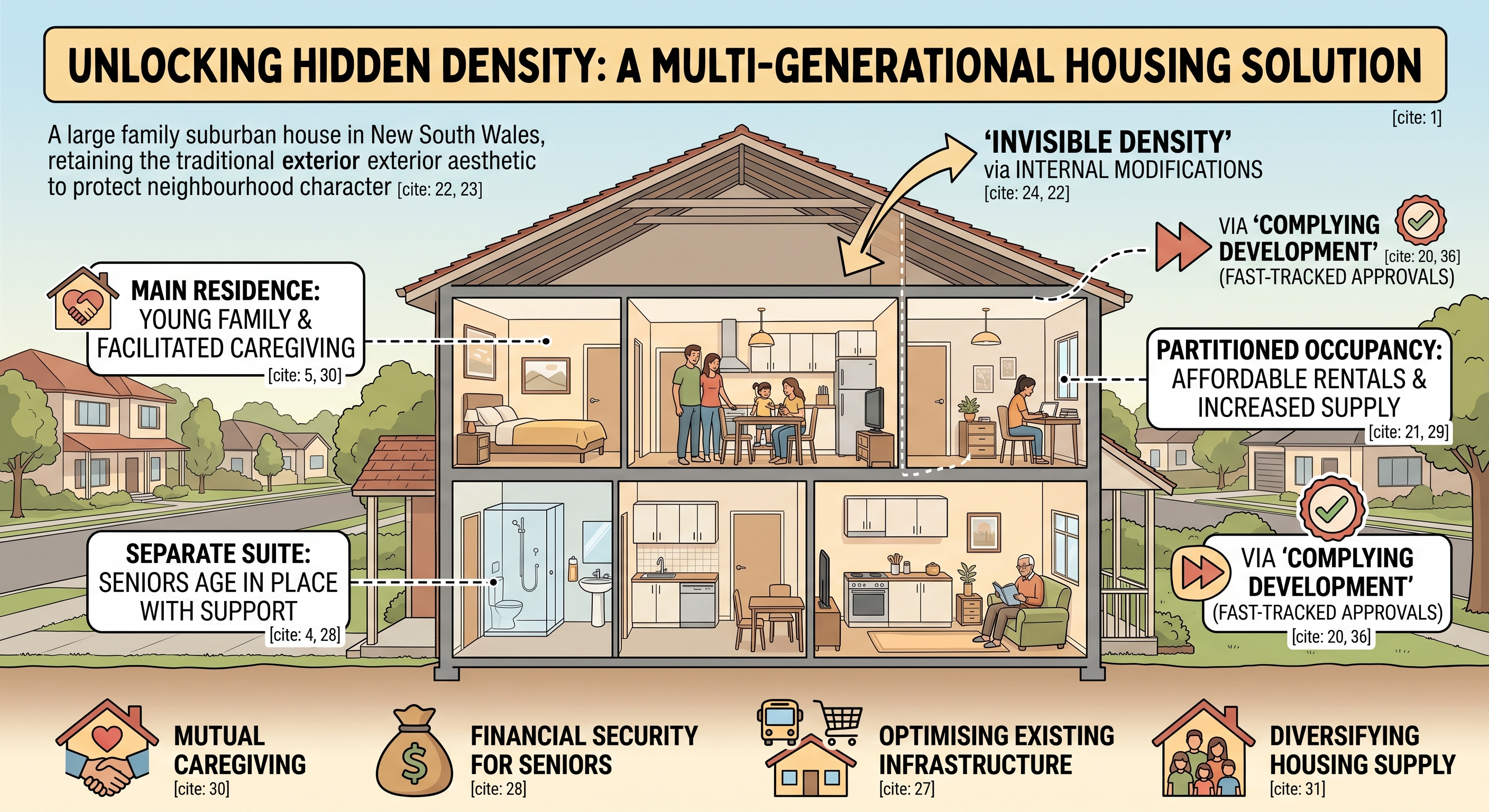
Under our proposed policy, an existing dwelling house could be modified into separate occupancies under "complying development" (a fast-tracked, rules-based approval process). This would allow different generations of a family to live under the one roof, or for part of a large house to be rented out.
To protect neighbourhood character, this complying development pathway could be restricted strictly to internal alterations or modifications to a dwelling house. By restricting the alterations to internal changes, there would be negligible visual or spatial impacts on the surrounding residential area. It is, effectively, "invisible density."
The Benefits
Implementing this simple planning reform would unlock a number of social and economic benefits:
Optimising Existing Infrastructure: Making better use of a large family home with good access to public transport and shopping facilities.
Financial Security for Seniors: Provides an income for elderly homeowners so they can maintain their home and age in place.
Boosting Affordable Rentals: Provides low-cost rental accommodation in well-serviced areas.
Facilitating Mutual Caregiving: Provides an opportunity for young adults to remain living in their family home and look after ageing parents, or for parents to assist with the care of grandchildren.
Diversifying Housing Supply: Provides for a variety of housing options in areas that currently lack them.
Hidden Density: Allows for greater housing density that is hidden, by adapting existing large homes into multiple occupancies, that would not change the character of residential areas.
Conclusion
We do not necessarily need to bulldoze our low-density suburbs to increase housing density and support our ageing communities. Our existing homes with good access to infrastructure, public transport and shops can provide the key. By reforming planning controls to allow these homes to be modified into separate occupancies via a fast-tracked, complying development pathway, we can respect the character of our neighbourhoods while solving some of the most pressing housing and social challenges of our time.