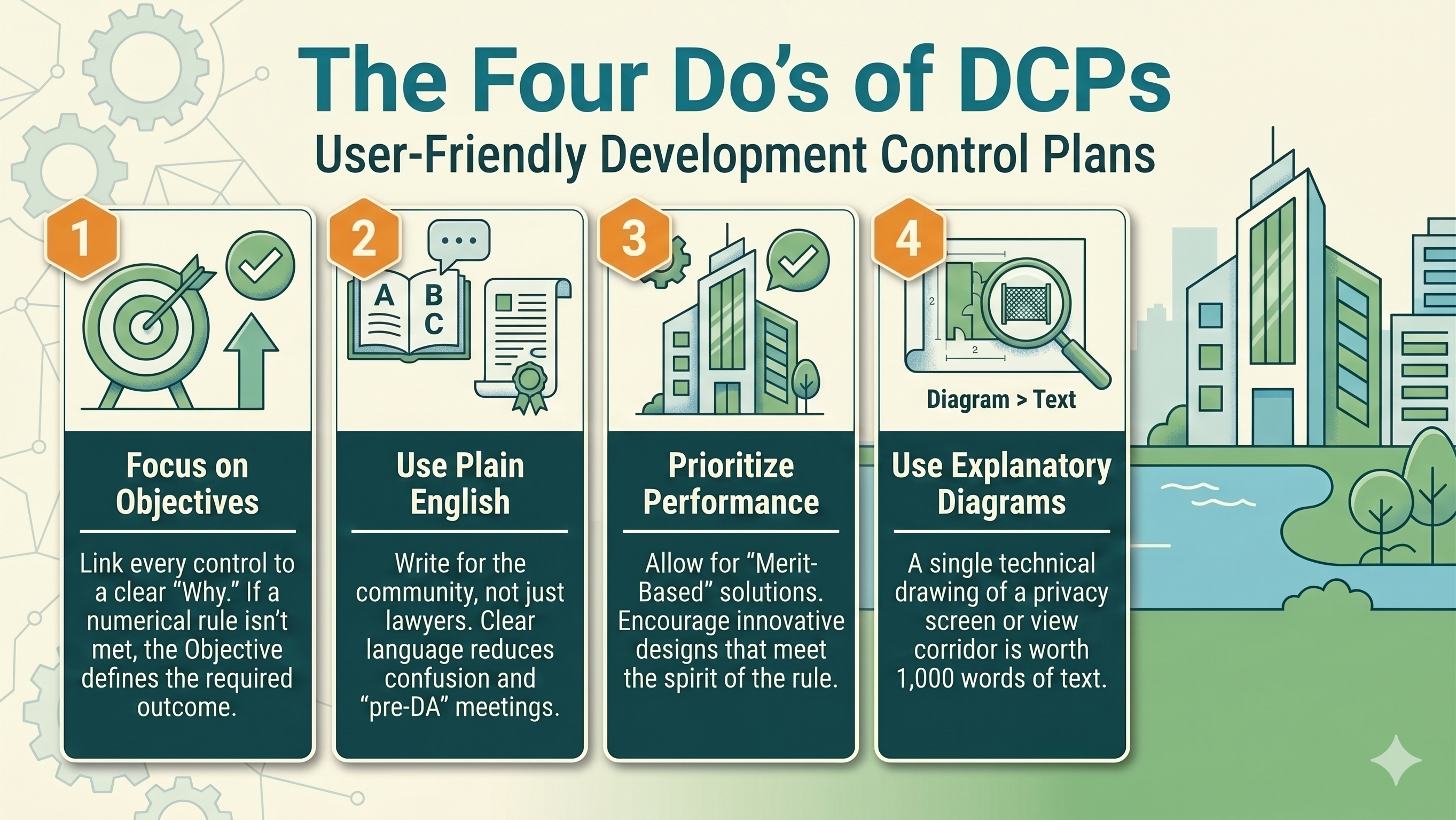
For most homeowners, applicants, and even seasoned architects, opening a local Council Development Control Plan (DCP) can feel like deciphering a foreign language. Traditionally, DCPs have been built by accumulation—years of amendments layered on top of ageing legacy frameworks, resulting in heavy technical jargon, repetitive rules, and a dizzying maze of cross-references.
At Berrys Bay Studio, our integrated team of town planners, architects, and builders views the planning framework from all angles, as we work with both councils and applicants. We know a DCP is only truly effective if it is easily understood by the community and practical on the construction site. Simply put, if the Local Environmental Plan (LEP) is the legal skeleton, the DCP is the detailed "instruction manual" that dictates design quality and environmental standards.
We recently put these principles into practice during our comprehensive peer review of Inner West Council’s new Draft DCP, which is currently on public exhibition. (You can view the project and see how these changes take shape on the Inner West Your Say platform).
Based on our recent review and our studio's "Policy to Practice" approach, here are five essential tips for drafting a modern, legally robust, plain-English DCP.
1. Separate the "Target" from the "Tool" (Objectives vs. Controls)
In drafting a DCP, clear objectives and controls are essential
The Objective is the target: It defines the desired environmental or design outcome, uses aspirational, qualitative language (e.g., "To protect neighbour privacy"), and must never include a metric.
The Control is the tool: It provides the specific, measurable standards to achieve that target (e.g., "A minimum 6m rear setback is required").
Under Section 4.15(3A) of the EP&A Act, the Land and Environment Court (and Councils) must allow for flexibility. If a developer proposes a brilliant design that misses a numerical control, the Court can still approve it if it successfully meets the underlying Objective. If your objectives are vague or just repeat the numerical control, you can leave Council defenceless in an appeal.
2. Eliminate the "Chapter Chase"
Traditional DCP layouts are often frustratingly fragmented. For example, someone wanting to build a basic house might have to look at Part 2 for general rules, jump to Part 3 for residential controls, and track down Part 4 just for parking.
When applicants are forced to navigate a puzzle of "read this part together with X," they inevitably miss important rules. This leads to incomplete applications, slower Council approvals, and unnecessary frustration for assessment officers.
The Fix: Group controls logically by building typology and local character. Instead of making applicants flip through an unknown number of chapters, best-practice design provides a consolidated summary table of key controls for each specific building type. Clear document navigation doesn't compromise statutory precision; it enforces it.
3. Trade Prescriptive Controls for Merit-Based Outcomes
A great DCP should act as a guide for high-quality design, not a rigid constraint that stifles architectural innovation. Overly prescriptive rules result in "control creep" and force designers into defensive architecture.
Take private open space dimensions, for instance. A traditional, highly rigid control might penalise a project simply because the outdoor area doesn't form a perfect, continuous rectangle at the rear of the block (such as a strict 4m by 6m rule).
The Fix: Draft performance-based controls linked to a clear "Why." By focusing on the ultimate objective—ensuring usable, private outdoor living—rather than a rigid numerical template, you encourage smarter, high-amenity outcomes (like a sunlit central courtyard) that work beautifully with a site's unique shape or orientation.
4. Avoid Vague Controls that Create "Legal Slippery Slopes"
While flexibility is important, vague language creates dangerous loopholes. If a control says, "Fences should be 1.2m, but Council may consider higher fences for extra privacy," every applicant will claim a need for privacy. Once a Council approves a few poorly justified exceptions, a bad legal precedent is set, lowering the character standard for the entire street.
The Fix: Use precise exceptions backed by clear command language ("must" or "is to be"). For example: "Solid fences up to 1.8m are only permitted on Classified Roads, provided a 1.5m landscaped setback is maintained." Tying exceptions to strict geographical or technical rules prevents character creep and makes controls simple to enforce.
5. Don't Repeat the LEP – DCPs should be Flexible
While the LEP (Local Environmental Plan) sets the "big picture" statutory rules (like land zoning and maximum heights), the DCP provides the fine-grain design details to ensure buildings look good and function well for the community.
A major 'don’t' in modern policy writing is copying rules from higher-level planning instruments. If you repeat height or FSR limits from the LEP inside your DCP, any change to the LEP rules, if the DCP doesn’t change, will create a legal conflict. Furthermore, avoid control creep. Having 50 controls for a simple fence makes it difficult for applicants and designers who may ignore the rules or look for loopholes.
Remember that a DCP is a guideline not a law. Rigid prohibitions may be overturned in favour of a merit decision.
The Berrys Bay Studio Advantage
Led by our Project Director, Lynne Sheridan—a seasoned Town Planner and former Acting Commissioner in the NSW Land and Environment Court—and Cody Sheridan, a licensed builder, our studio stress-tests planning policies against both legal defensibility and on-site buildability.
Our work on the Inner West Council Draft DCP focused on plain English writing, stripping away unnecessary technical jargon, standardising definitions to eliminate ambiguity, and writing clear, performance-based objectives aligned with the controls—all while strictly protecting Council's statutory position.
When a DCP is clear, concise, and written in plain English, it doesn't just benefit the community. It protects Council from legal risk, slashes assessment timelines, and actively shapes a more vibrant, well-designed local environment.