The NSW Government wants to speed up the planning system, and their recent proposal for a Complying Development Certificate (CDC) "variation pathway" is a step in the right direction. The goal? To fast-track minor changes and cut through the red tape holding up housing.
But while the intent is great, the execution needs a rethink. If we want this to actually work for local councils and everyday homeowners, we need to tweak the mechanics so it doesn't accidentally cause more delays. We need a system that reflects how local government actually operates, rather than just putting a ticking clock on an already stressed system.
Maximising Council Resources (Without the Pressure Cooker)
Right now, councils across NSW are under immense pressure to clear DA backlogs and get homes built. But the proposed CDC variation pathway comes with a strict 10 to 20-day assessment window and the threat of a "deemed approval" if they miss the deadline.
Put yourself in a council planner's shoes: if you're strapped for time and facing complex legal risks, the safest move is simply to hit "refuse." Unfortunately, this just forces the applicant to start all over again with a standard Development Application (DA), wasting everyone's time and money on low-risk issues.
Instead, if we integrate this variation pathway directly into the standard DA process, councils can rapidly clear minor hiccups without the pressure-cooker environment. It lets them hit their state-mandated targets, save money, and free up planners to focus on the big, complex projects that actually shape the future of our communities.
A Seamless Journey for Homeowners and Builders
To make this work, the variation tool needs to be completely seamless. We can achieve this through two simple changes:
• No Penalty for Trying: If a variation isn't approved in the fast-track window, it shouldn't be a hard "no." The application should simply transition into a normal DA assessment. No withdrawn applications, no paying new fees, and no restarting the clock from zero.
• Keep the Paperwork Proportional: Right now, varying a standard usually requires a heavy, legally complex Clause 4.6 document. For a tiny variation, that’s overkill. We should use a simple, streamlined 'Variation Justification' form that saves time for both the applicant and the assessing officer.
Case Study: Let's Talk About a Simple Variation
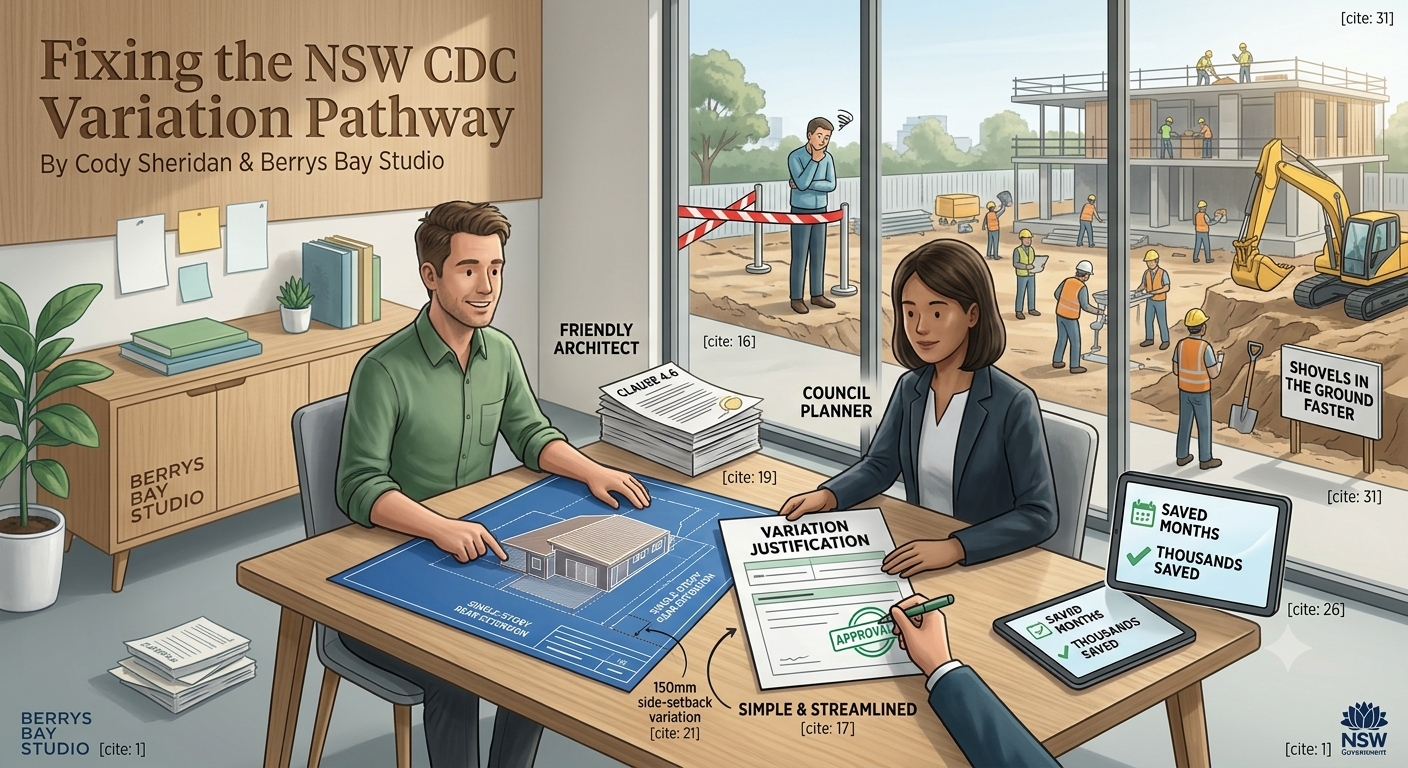
Let’s look at a real-world example. Imagine you’re a homeowner coming to us at Berrys Bay Studio for a single-story rear extension. The design is great, it respects the neighbours, and it ticks almost every box. But, because of a minor architectural detail, it steps into the State’s CDC side-setback rule by just 150mm—about the width of your smartphone.
Under the current rigid rules, that tiny 150mm triggers a full, months-long DA process.
Under our proposed integrated pathway, we would just submit a simple 'Variation Justification' alongside your application. We’d essentially say to the council, "Hey, this setback matches all the other houses on the street and fits the local character."
The assessing officer can look at that, agree it makes total sense, and issue the variation on the spot. You save months of stress and thousands of dollars, and the council gets to log a quick win on their efficiency metrics. It’s a win-win.
Conclusion
At the end of the day, the State government has the right idea: we need to make building and renovating easier. But putting a strict ticking clock on minor variations isn't the magic bullet.
As professionals who navigate these statutory frameworks daily at Berrys Bay Studio, we know that forcing minor variations through rigid compliance pathways is fundamentally counterproductive. By pivoting to an integrated, discretionary DA assessment model, we can empower consent authorities to resolve low-risk non-compliances swiftly while mitigating their legal exposure. It is a pragmatic, necessary reform that shifts the focus from policing arbitrary numerical standards to delivering high-quality built environments—ultimately cutting the red tape and getting shovels in the ground faster.